There is a metric that can cut your AI agent costs by 80%. The Manus AI engineering team called it "the single most important metric for a production-stage AI agent." And I have talked to dozens of teams building agents in production who have never looked at it.
KV-cache hit rate is the percentage of input tokens on a given model call that are served from a previously computed key-value state rather than reprocessed from scratch. It matters because a high hit rate can reduce input token costs by up to 90 percent, making it the single most impactful cost lever in a production agent. Unlike token count reduction, which shrinks the prompt, cache hit rate measures how much existing context the provider can skip recomputing.
It is KV-cache hit rate.
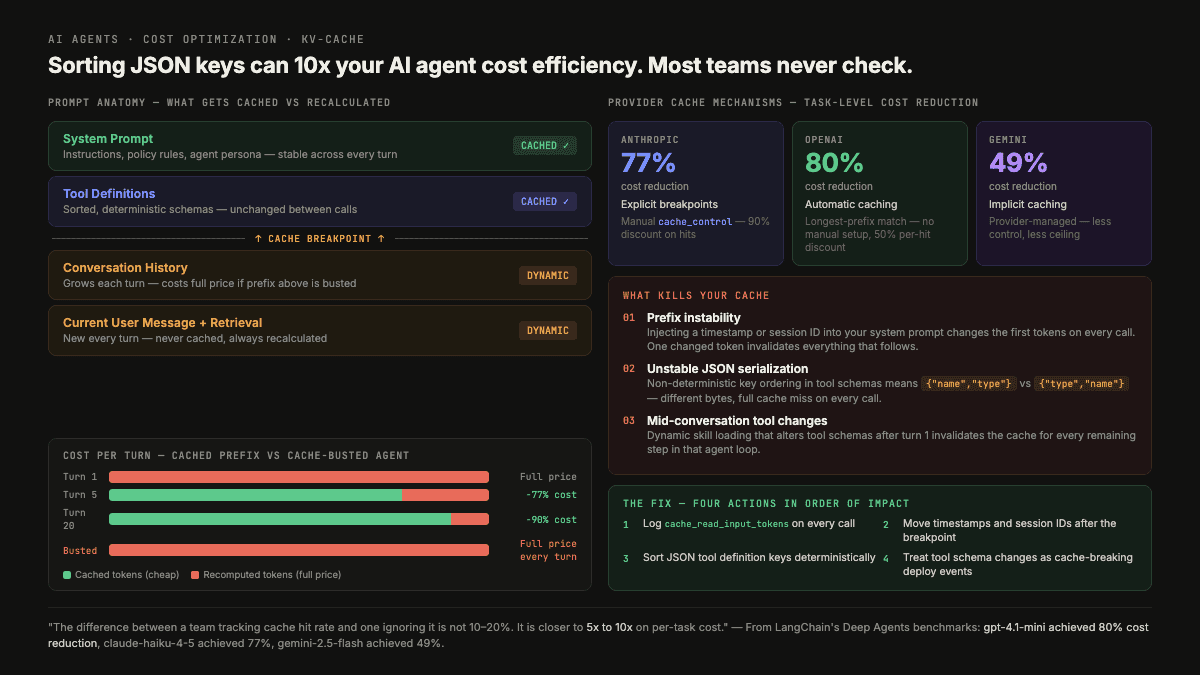
Table of Contents#
- What the Discount Actually Looks Like
- How KV-Cache Actually Works
- The Ways Teams Kill Their Own Cache
- Provider Differences That Actually Change Your Architecture
- The Fix: Treat It Like a First-Class Metric
- What is Coming Next: Semantic Caching
- What to Actually Do
- How I Would Run This in Production
- What I Would Measure
- Where This Connects
- FAQ
Not token count. Not model choice. Not batch size. Cache hit rate.
I want to be specific about why this matters, because "caching" sounds boring until you see the numbers.
What the Discount Actually Looks Like#
On Anthropic's Claude models, cached tokens cost 0.1x the base input price. That is a 90% discount. Cache writes cost 1.25x for a 5-minute TTL or 2.0x for a 1-hour TTL, so there is a real cost to warming the cache, but it pays off fast on any multi-turn agent loop.
OpenAI handles it differently. Their automatic prompt caching gives roughly 50% cost reduction on cache hits, no manual setup required. You get less savings per hit but also less to configure.
From LangChain's Deep Agents benchmarks, the numbers across providers look like this:
claude-haiku-4-5with Anthropic's explicit breakpoints: 77% cost reductiongpt-4.1-miniwith OpenAI's automatic longest-prefix caching: 80% cost reductiongemini-2.5-flashwith implicit caching: 49% cost reduction
At meaningful scale, the difference between a team tracking cache hit rate and one ignoring it is not 10-20%. It is closer to 5x to 10x on per-task cost. That is not a rounding error. That is the difference between a viable product and one that bleeds money at the worst possible time.
How KV-Cache Actually Works#
The mechanism is simple. When you send a prompt to a model, the model processes every token in that prompt through its attention layers, generating what is called a KV (key-value) state. This is the expensive computation.
KV-caching stores a snapshot of that state after processing a fixed prefix. The next request that starts with the same prefix can skip the computation for those tokens entirely. The model picks up from the cached state and only processes the new tokens.
For a long-running agent with a large system prompt, tool definitions, and accumulated conversation history, the prefix can represent the majority of total tokens. If you are hitting cache on every turn, you are paying full price for almost nothing.
The savings compound as the agent runs longer. Each additional turn reuses the same cached prefix, so a 20-turn task shows dramatically more savings than a 3-turn task.
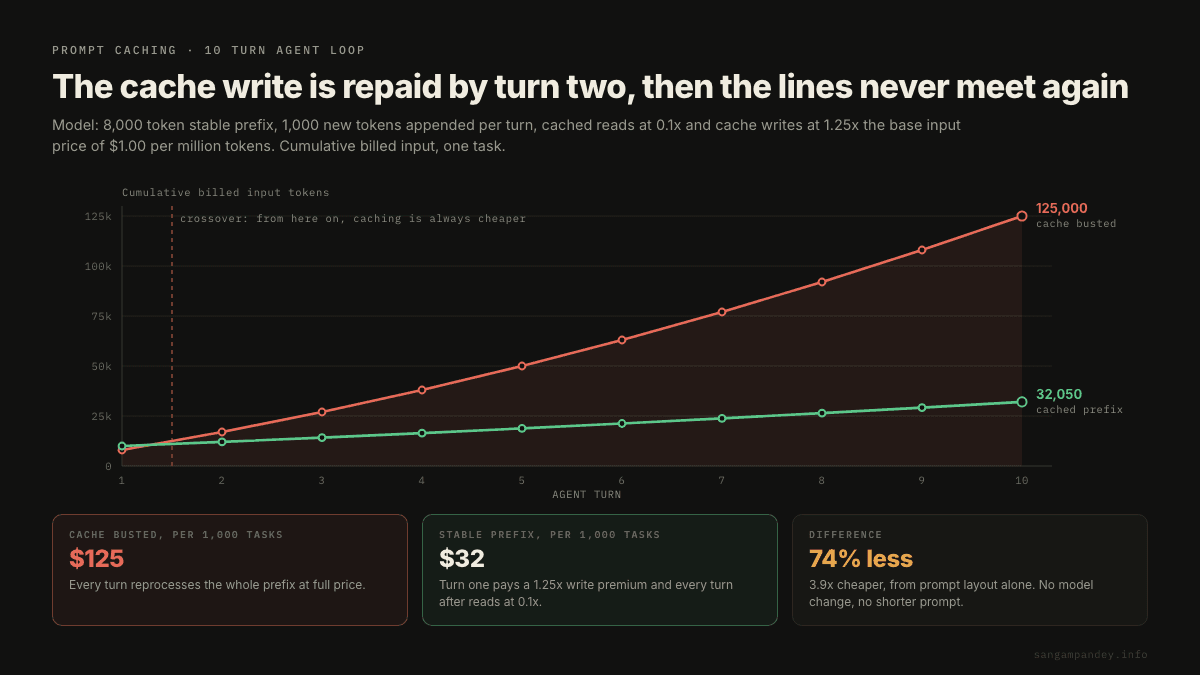
Worth noting where the crossover sits. On turn one the cached run is actually more expensive, because writing the cache costs 1.25x. By turn two it is ahead, and it never gives that lead back.
How Do Teams Kill Their Own Cache?#
This is where most teams lose. The cache exists, but something keeps busting it.
Prefix instability. KV-cache is exact-match on the prefix. A single-token difference, anywhere in the system prompt, invalidates everything that follows. The most common culprit: injecting a timestamp or session ID into the system prompt on every call. The system prompt looks the same to you, but the model sees a different first few tokens every time.
Unstable JSON serialization. If you are building tool definitions programmatically and serializing them to JSON, non-deterministic key ordering breaks cache on every call. JavaScript objects and Python dicts do not guarantee insertion order in all contexts. If {"name": "search", "type": "function"} comes out as {"type": "function", "name": "search"} on the next request, the cache miss cascades through the entire context chain for every subsequent step in that agent loop.
Tool definition changes mid-conversation. This one is subtle. If your agent dynamically loads skills or tools based on context, and those tool schemas change at any point, the cache is invalidated for everything that came after the change point in the conversation history. Every remaining turn pays full price.
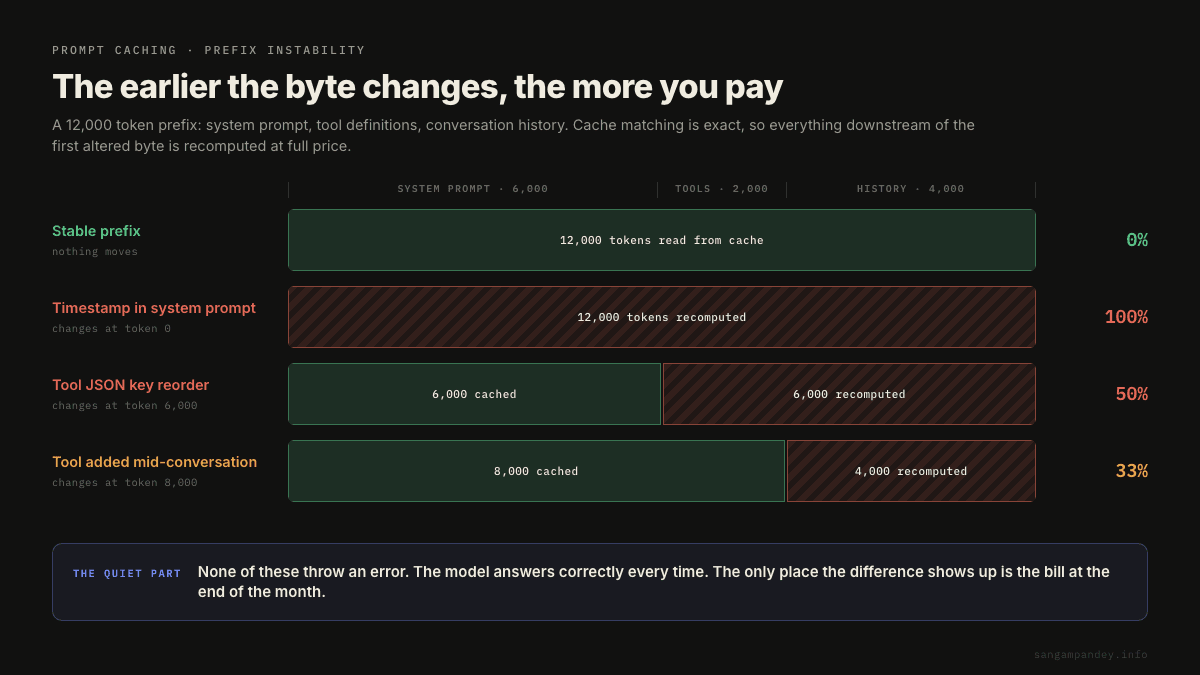
The frustrating part is that none of these issues throw errors. The model responds correctly. The only signal is the bill.
Which Provider Differences Actually Change Your Architecture?#
Anthropic and Gemini use explicit cache breakpoints. You mark specific positions in your prompt where caching should be anchored. This gives you control: put the breakpoint after your stable system prompt and tool definitions, before any per-request context. If a new tool gets added mid-conversation, only the context after your breakpoint is re-computed.
| Provider / Model | Cache Mechanism | Benchmark Task-Level Cost Reduction |
|---|---|---|
| Anthropic claude-haiku-4-5 | Explicit cache breakpoints (manual cache_control) | 77% |
| OpenAI gpt-4.1-mini | Automatic longest-prefix caching (no setup required) | 80% |
| Google gemini-2.5-flash | Implicit caching (provider-managed) | 49% |
Without explicit breakpoints, adding a new skill mid-conversation busts the entire cache instead of just the incremental addition.
OpenAI uses automatic longest-prefix caching. No breakpoints to manage, but you also do not control where the cache anchors. The system finds the longest matching prefix automatically. Simpler to set up, slightly less savings ceiling, and less control over what gets invalidated when things change.
Fireworks and Baseten have limited or no KV-cache support at this point. If cost at scale is a constraint, that is a real architectural consideration when choosing providers.
How Should You Treat Cache Hit Rate as a First-Class Metric?#
Here is what actually needs to change in your agent code. Anthropic's API response includes cache_read_input_tokens and cache_creation_input_tokens in the usage object. Log both on every call. Track hit rate over time. Alert when it drops below your baseline.
import { anthropic } from "@anthropic-ai/sdk";
import {
  createAnthropic,
  AnthropicProviderSettings,
} from "@ai-sdk/anthropic";
import { wrapLanguageModel } from "ai";
import { anthropicPromptCachingMiddleware } from "@langchain/anthropic";

// Using LangChain's prompt caching middleware
const model = new ChatAnthropic({
  model: "claude-haiku-4-5",
  clientOptions: {
    defaultHeaders: {
      "anthropic-beta": "prompt-caching-2024-07-31",
    },
  },
});

// The middleware automatically adds cache_control breakpoints
// to messages that exceed the minimum cacheable token count
const modelWithCaching = model.pipe(anthropicPromptCachingMiddleware());

// Log cache metrics from every response
async function callWithCacheTracking(messages: BaseMessage[]) {
  const response = await modelWithCaching.invoke(messages);

  const usage = response.response_metadata?.usage;
  if (usage) {
    const cacheHits = usage.cache_read_input_tokens ?? 0;
    const cacheMisses = usage.cache_creation_input_tokens ?? 0;
    const totalCacheable = cacheHits + cacheMisses;
    const hitRate = totalCacheable > 0 ? cacheHits / totalCacheable : 0;

    console.log({
      cache_hit_tokens: cacheHits,
      cache_miss_tokens: cacheMisses,
      hit_rate: hitRate,
      // Alert if hit rate drops below 60% baseline
      alert: hitRate < 0.6 ? "CACHE_HIT_RATE_LOW" : null,
    });
  }

  return response;
}
The key discipline here is treating tool definition schema changes as cache-breaking release events, not routine updates. Same way you'd treat a database migration or a breaking API change. If you add a tool or modify a tool's schema, your cache hit rate will drop on the next deployment. That is expected. What is not acceptable is not knowing it happened.
What is Coming Next: Semantic Caching#
The approach I have described so far is all exact-match prefix caching. Same prefix bytes, same cache hit. That works well for the stable parts of an agent's context.
The next layer is semantic caching. Tools like Redis LangCache can return cached responses for prompts that are semantically similar but not byte-identical. A user asking "what is the weather in New York" and another asking "New York weather today" can share a cached response if the answer hasn't changed.
In high-repetition workloads, particularly customer service agents or document Q&A systems where many users ask similar questions, semantic caching shows up to 73% cost reduction. The tradeoff is response freshness and the added complexity of a similarity threshold. But for the right use cases, it is a meaningful additional layer on top of KV caching.
What to Actually Do#
Four concrete things, in order of impact:
-
Start logging cache metrics today. Add
cache_read_input_tokensandcache_creation_input_tokensto your observability stack on every model call. You cannot improve what you are not measuring. -
Audit your system prompt for dynamic content. Anything that changes between requests, including timestamps, session IDs, or per-user state, needs to come after your cache breakpoint, not before it. Stable content belongs at the top.
-
Fix your JSON serialization. Sort tool definition keys deterministically before serializing. This is a two-line fix with enormous downstream impact on cache consistency across an entire agent loop.
-
Treat tool schema changes as deployment events. Before releasing any change to a tool's schema, accept that cache hit rate will drop for that agent type until the new prefix warms. Plan for it. Monitor the recovery.
Cache hit rate is boring infrastructure work. Nobody is going to write a blog post about how they achieved 77% cost reduction by sorting JSON keys. But the engineers who treat this as a first-class metric are running the same agents at one-fifth the cost of the teams who do not.
That is not a minor optimization. At any real scale, it is the difference between an AI product that makes economic sense and one that does not.
Infographic suggestion: This post benefits from a visual explainer.
Helicopter view: A single-slide summary showing the three providers (Anthropic, OpenAI, Gemini) with their cache discount percentages, one column for "cache killers" (three bullets), and one row for "the fix" (four action items).
Detailed view: A step-by-step flow diagram showing an agent loop across 5 turns, tracking which tokens are cache hits vs. misses at each turn, with cumulative cost on the Y-axis. Show how cost diverges between a well-cached agent and a cache-busted one over the course of a long task.
How I Would Run This in Production#
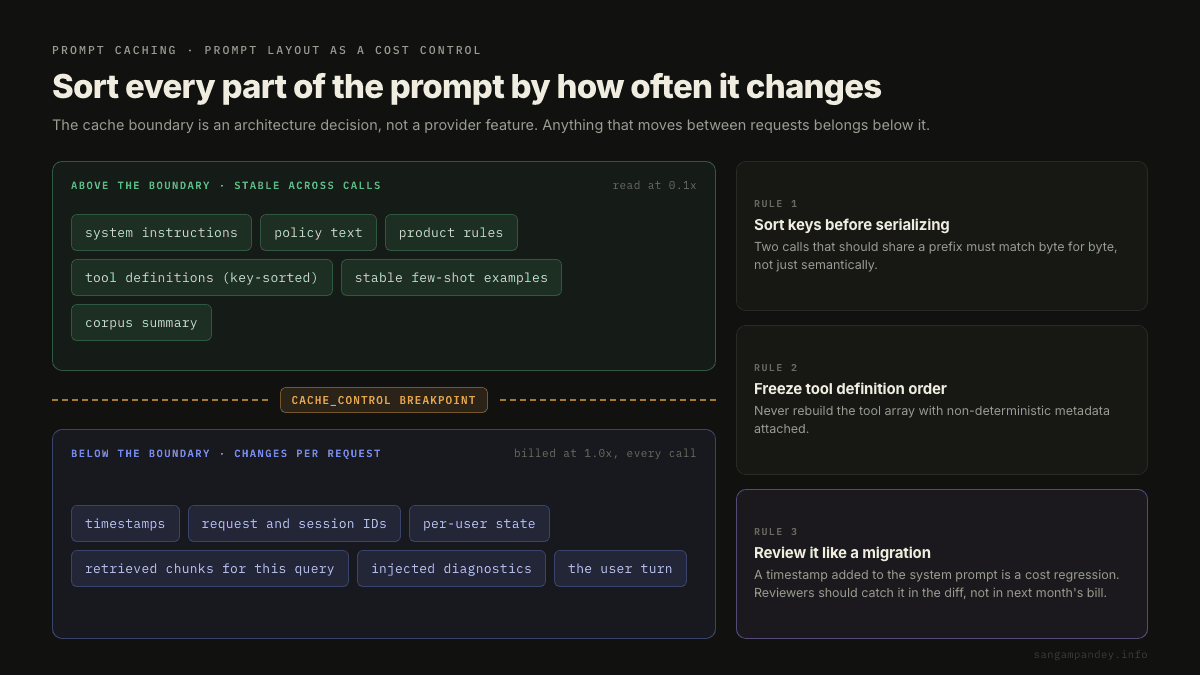
I would treat prompt caching as an architecture constraint, not a provider feature. The first pass is to separate static context from dynamic context. Tool schemas, policy text, product rules, and stable examples should sit before the changing user turn. Timestamps, request IDs, temporary retrieval snippets, and per-user state should sit after the cache boundary.
The next pass is serialization. A surprising amount of cache waste comes from objects that are semantically identical but serialized differently. Sort keys. Freeze tool definition order. Avoid rebuilding tool arrays with non-deterministic metadata. If two calls should share a prefix, their byte representation should actually match.
Then I would add provider-specific accounting. Claude, OpenAI, Gemini, and self-hosted models expose different cache signals and price the behavior differently. A single abstract metric is useful for product reporting, but debugging still needs provider detail. Otherwise you cannot tell whether the failure is prompt structure, model routing, or provider behavior.
Finally, I would make cache hit rate visible in code review. If a change inserts a timestamp into the system prompt, changes the order of tools, or mixes retrieval context into the static section, reviewers should notice. This is not performance polish. It is production cost control.
What I Would Measure#
The practical dashboard has four lines: cached input tokens, uncached input tokens, output tokens, and total cost per successful workflow. Cache hit rate by itself can hide growth in output tokens. Cost by itself can hide the structural reason the bill changed.
I would also track cache breakpoints by release. If cost jumps after a deploy, you need to know whether prompt layout changed, tools changed, retrieval changed, or traffic mix changed. Without release correlation, teams waste hours arguing about model prices while the real issue is a reordered JSON object.
The metric I like most is cost per completed task, grouped by task type. It keeps the conversation grounded. A long-running research agent can have a lower hit rate than a simple classifier and still be healthy if the task economics make sense.
Where Does This Connect to the Rest of the Production Agent Stack?#
This post is one piece of the production agent lifecycle. The adjacent pieces matter because the failure usually does not stay inside one layer. A tracing problem becomes an eval problem. An eval problem becomes an ownership problem. A routing problem becomes a cost and security problem if nobody can see what changed.
- The Physics of Prompt Caching
- The Static-First Prompt Architecture
- LangGraph Prompt Caching: Patterns and Anti-Patterns
- Model Routing for Practitioners
- Treating Prompts Like Code
If you are using this as a checklist, read those posts as dependencies rather than as optional background. The stack only becomes reliable when the evidence loop, the release loop, and the security loop all point at the same production behavior.
FAQ#
What is a KV cache in an LLM?#
A KV cache stores the key and value tensors produced while a model processes prior tokens. Reusing those tensors lets the model avoid recomputing stable prompt prefixes, which can reduce latency and input cost when the provider supports caching.
Why do small prompt changes break caching?#
Caching usually depends on an identical prefix. If a timestamp, reordered tool schema, or changed system instruction appears before the cache boundary, the provider cannot reuse the prior computation. The prompt looks similar to a human but different to the cache.
Should retrieval context be cached?#
Usually not by default. Retrieval context changes per query, so it belongs after stable instructions and tool definitions. If you have a stable corpus summary that applies across many turns, that summary may be cacheable, but query-specific chunks should remain dynamic.
How do I debug a cache miss?#
Compare the exact serialized prompt prefix from a cache hit and a cache miss. Look for timestamps, random IDs, object key ordering, tool order changes, user-specific state, or injected diagnostics before the static boundary.
Does caching reduce output token cost?#
No. Prompt caching mostly reduces the cost and latency of processing input prefixes. Output tokens still have to be generated. That is why you need to monitor output length separately.
What is a healthy cache hit rate?#
It depends on the workflow. A repetitive support agent should have a high hit rate because most instructions and tools are stable. A research agent with highly variable context may be lower. The right benchmark is cost per completed task, not a universal percentage.
Implementation Review Checklist#
Before I would call this production-ready, I would ask five questions in the review. First, does the team know which artifact changed because of this lesson? A trace field, eval case, prompt file, routing rule, dashboard, or security policy should be visible in the repo or the runbook. If the only output is agreement, the lesson has not landed yet.
Second, can the team reproduce the failure mode in a lower environment? Production AI work gets messy when the only evidence is a screenshot, a Slack thread, or a vague user complaint. A reproducible example gives the team something concrete to test against after the fix.
Third, does the fix have an owner after the first merge? Most agent systems decay slowly. Datasets go stale, prompts drift, routing rules stop matching traffic, and permissions expand. The owner is the person who notices that drift before it becomes an incident.
Fourth, is rollback obvious? If a prompt, model, parser, evaluator, or security rule makes behavior worse, the team should know how to return to the last known-good version without rewriting the system under pressure.
Fifth, did the incident or improvement strengthen the loop? A good production process compounds. The trace becomes an eval. The eval becomes a gate. The gate becomes a safer release. That is the practical standard I would use for every idea in this series.
I would also ask whether the change makes the system easier to explain to a new teammate. Production AI stacks fail when the important behavior lives in someone s memory. If the reason for a prompt rule, routing threshold, eval example, or tool permission is not written down, the next person will eventually delete it while cleaning up what looks like accidental complexity.
The review should include one negative example. Show the input that used to fail, the trace or eval result that made the failure visible, and the current behavior after the change. This keeps the team grounded in evidence. It also stops the review from becoming abstract, which is where AI engineering discussions often drift.
For agent systems, I would check the cost impact and the quality impact together. A fix that improves quality by calling a frontier model three extra times may be correct for a regulated workflow and wrong for a low-margin support workflow. A cost reduction that removes useful context may look good for a week and then show up as worse user outcomes. The trade-off has to be explicit.
The last check is operational ownership. If the change creates a new dashboard, who looks at it? If it creates a new eval, who updates it? If it creates a new permission boundary, who approves exceptions? The difference between a strong production practice and a temporary cleanup is usually whether the maintenance path is obvious.
None of this needs to be heavy. A short pull request note, one linked trace, one eval case, and one owner are enough for many changes. The point is to leave a trail that future engineering work can build on. That is how AI systems become more reliable over time instead of slowly collecting unexplained rules.