There is a phrase that is been getting louder in AI circles this year: self-improving agents. It sounds like the setup for a sci-fi plot. But the reason I am writing this is because it is already in production, at least one version of it is, and most explanations I have seen either oversell what is real or bury the interesting engineering in vague hand-waving.
Let me be specific about what exists today, what is 12 months out, and what is still firmly in research territory.
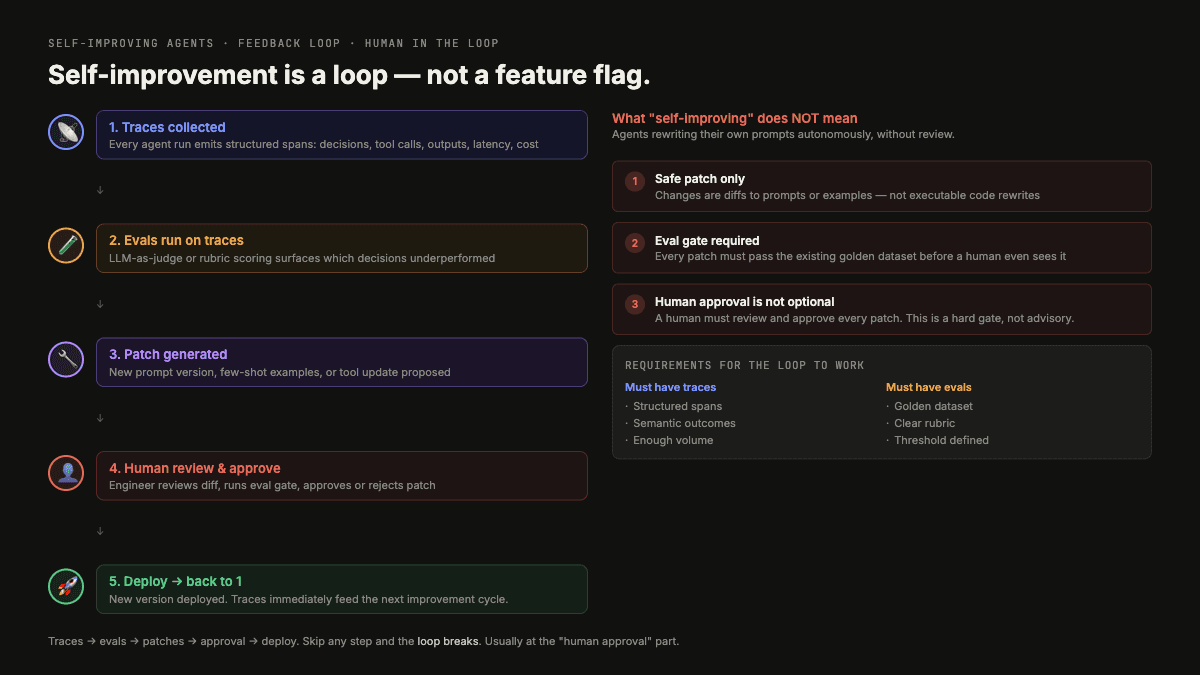
Table of Contents#
- Three Maturity Levels, Not One
- What LangSmith Engine Actually Does
- The Four Technical Requirements That Actually Enable This
- The Constraint Nobody Talks About Enough
- The 24-Month Trajectory
- What to Do Before You Need It
- How I Would Run This in Production
- What I Would Measure
- Where This Connects
- FAQ
Three Maturity Levels, Not One#
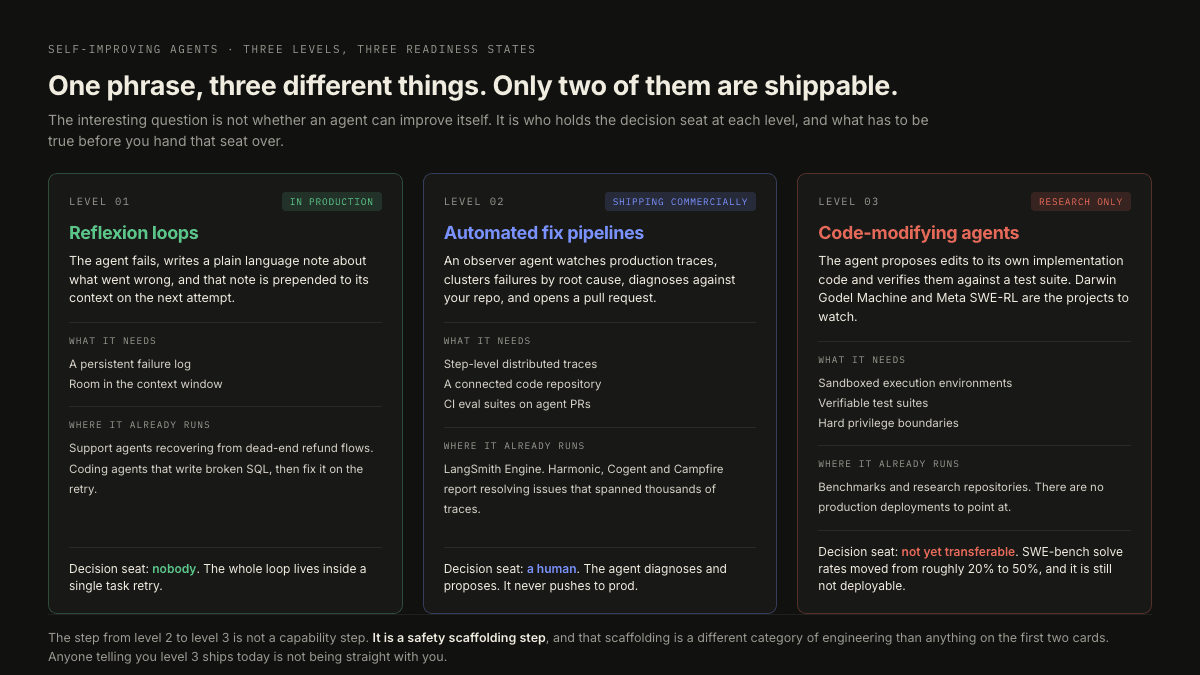
The phrase "self-improving agent" is doing a lot of work. It conflates at least three distinct things that are at completely different stages of readiness.
Level 1: Reflexion loops. These are in production right now. The idea is straightforward: when an agent fails at a task, it writes a natural language description of what went wrong and why. On the next attempt, that failure log gets prepended to its context. The agent now has access to its own recent mistakes as memory.
This sounds almost too simple, but it works. Customer service agents that hit dead ends on refund workflows. Coding agents that write broken SQL then fix it on retry. The mechanism does not require any new infrastructure beyond a persistent log and a context window. Reflexion-style architectures are live across multiple production systems right now.
Level 2: Automated fix pipelines. This is where it gets commercially interesting. LangSmith Engine, which launched earlier this year, is the clearest example. The architecture looks like this: an external observer agent monitors production traces continuously. When it detects failures or quality degradations, it clusters them by root cause, diagnoses against your actual codebase context, then proposes a fix. That fix comes as a GitHub PR. A human approves or rejects. The agent never pushes to prod on its own.
So the improvement loop is real. The agent is genuinely diagnosing and proposing code changes. But humans are still in the decision seat. This is not a limitation to be embarrassed about; it is a sensible engineering boundary for 2026.
Level 3: Code-modifying agents. This is research. Darwin Godel Machine and Meta's SWE-RL are the projects worth tracking here. They allow agents to propose edits to their own implementation code. On SWE-bench, this approach raised task solve rates from around 20% to 50%. That is a significant jump.
But these systems require sandboxed execution environments, verifiable test suites, and very careful privilege boundaries. They are not something you'd ship to production without an entirely different category of safety scaffolding. Anyone telling you this is deployable today is not being straight with you.
What LangSmith Engine Actually Does#
Since Level 2 is where most engineering teams will operate in the next 12 months, it is worth going into the details.
The system monitors five signal categories: explicit errors (tool call failures, timeouts), online evaluator failures when quality scores drop below threshold, trace anomalies like latency spikes or unexpected step counts, negative user feedback, and out-of-scope behaviors.
The detect-diagnose-fix loop runs on a specific cadence. The initial audit costs around 30-40 LCUs. After that, recurring scans run every six hours at 10-15 LCUs each. This is not magic; it is a monitoring service that reasons about agent behavior the way an on-call engineer would, just continuously and at scale.
Two technical requirements are worth flagging for anyone setting this up. First, you need a connected GitHub repo. Without it, the system can cluster failures but cannot diagnose root causes or draft fixes. It becomes a classification tool, which is useful but not the full loop. Second, it currently uses LangChain-managed inference only. BYOK is not supported in the current beta, which matters if you have specific model or vendor requirements.
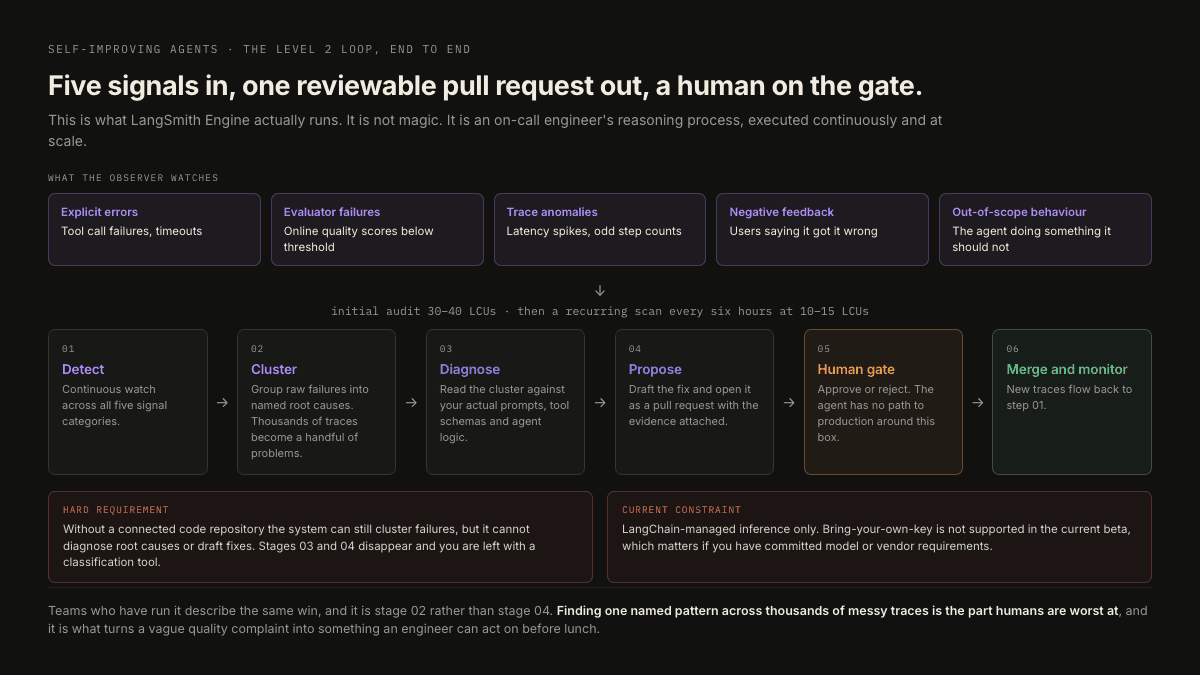
The teams that have used it report something specific: Harmonic's Austin Berke described it as saving hours of digging by identifying emerging failure modes and suggesting evals and code changes proactively. Cogent and Campfire used it to resolve issues affecting thousands of traces. These are not theoretical wins.
The Four Technical Requirements That Actually Enable This#
If you are building toward self-improving agents rather than just using a commercial product, there are four things you need to get right.
Full-fidelity distributed tracing. Not request-level logging. Step-level, with correlation IDs that let you reconstruct exactly what the agent was doing at each decision point. Without this, you are debugging blind.
Semantic failure clustering. Raw traces are unworkable at scale. Before any agent, or human, can reason about failure patterns, you need those traces clustered into named categories. "Tool timeout on CRM API" is analyzable. A thousand unlabeled stack traces are not.
Codebase context integration. This is what separates surface-level diagnosis from root cause analysis. When a diagnosing agent has access to your actual prompt templates, tool schemas, and agent logic, its fix proposals are dramatically more accurate than when it is just looking at traces in isolation.
Sandboxed evaluation execution. Proposed fixes need to be tested before merging. That means CI eval suites that run automatically on agent-authored PRs. If you do not have this, you are back to manual review of every change, which defeats the purpose.
None of these are exotic. They are engineering fundamentals that most teams haven't fully implemented for their agents yet.
The Constraint Nobody Talks About Enough#
Here is the thing that gets glossed over in most coverage of self-improving agents: this only works reliably in domains with objectively verifiable outcomes.
Code either passes the test suite or it does not. An agent's SQL query either returns the right rows or it does not. These are verifiable. You can close the feedback loop automatically.
Marketing copy quality is not verifiable. Strategic recommendations are not verifiable. Any domain where success is subjective, contested, or context-dependent remains largely manual. The feedback loops you'd need do not exist yet.
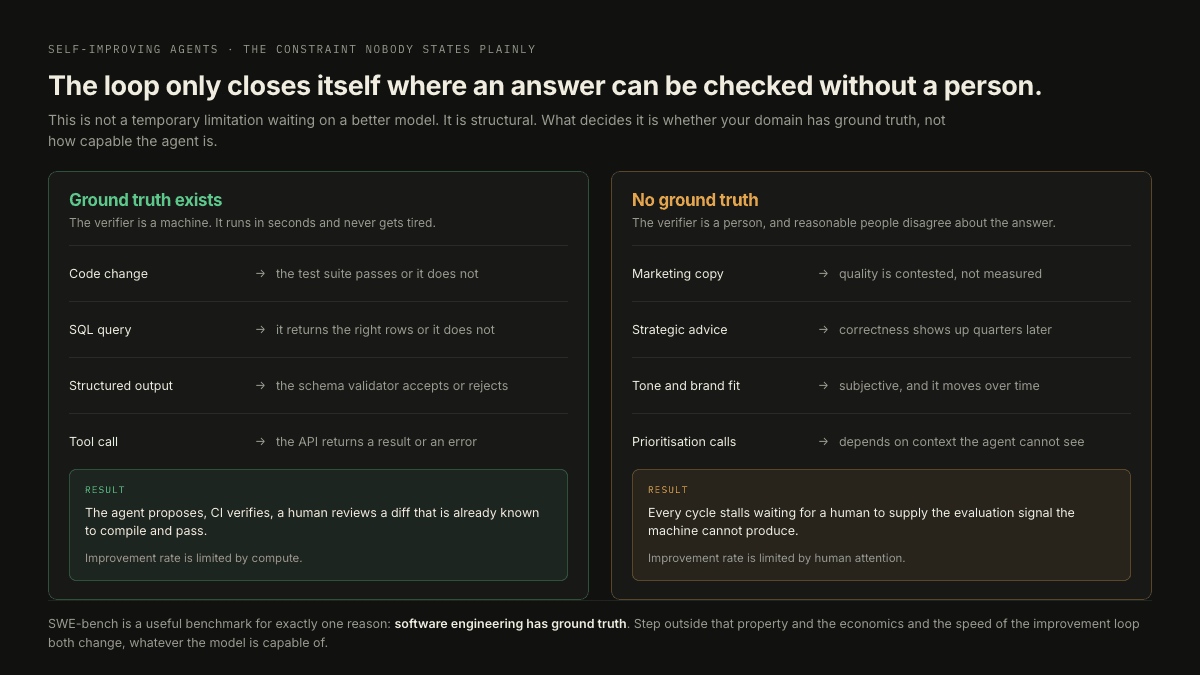
This is not a temporary limitation. It is structural. The reason SWE-bench is a useful benchmark is because software engineering has ground truth: tests pass or fail. The moment you move into domains without that property, you need humans to provide the evaluation signal, and that changes the economics and speed of the improvement loop considerably.
The 24-Month Trajectory#
Here is how I see this playing out, and I am being conservative:
Right now, in 2026: agents detect and diagnose problems; humans approve fixes. This is the LangSmith Engine model. It is live.
In 12 to 18 months: agents auto-merge low-risk prompt fixes without human approval, with monitoring in place. Humans still review code changes. The trust boundary shifts but does not disappear.
In 24 to 36 months: agents manage the full improvement loop for bounded domains. Code, data pipelines, structured workflows. Human oversight moves from the PR level to the policy level. You are setting the rules, not approving individual changes.
One external forcing function worth tracking: EU AI Act high-risk obligations come into full effect in August 2026. If your agents touch hiring, credit, healthcare, or critical infrastructure, this has direct implications for how you document and audit automated changes. Getting your tracing and audit trails right now is not just good engineering, it is compliance groundwork.
What to Do Before You Need It#
Four concrete action items for teams that want to be ready:
-
Instrument tracing at the step level now. Not after you start having problems. The data you need to power diagnostic agents has to be collected while the system is running normally. Retrofitting traces after a failure is messy. Tools like LangSmith, Langfuse, or OpenTelemetry-compatible setups all work. Pick one and get step-level spans in place.
-
Build eval datasets from production traces, not synthetic data. Synthetic datasets go stale fast. Worse, they do not reflect the actual distribution of inputs your agent sees. Pull real traces, label a set of them for quality, and update that dataset regularly. A stale eval dataset gives you false confidence; it is worse than no signal.
-
Establish trust thresholds before you need them. Which changes can auto-merge: trivial prompt wording fixes, probably yes. Structural changes to tool call logic, no. Model swap, absolutely not without review. This decision tree should be written down and agreed on before you are looking at an agent-authored PR at 11pm. Work out the policy in advance.
-
Make sure your CI/CD can handle agent-authored PRs. Test it. Have an agent (or a script pretending to be one) open a PR and walk it through your full pipeline. GitHub Actions, Buildkite, whatever you use: verify that the pipeline runs, evals execute, and the results are visible to reviewers. This sounds obvious. Teams discover broken assumptions here regularly.
Self-improving agents are not magic and they are not far-future speculation. One version of them is running in production today. The engineering work to get ready for the next version is not exotic. It is instrumentation, eval infrastructure, and policy decisions. The teams that do that work now will have a meaningful advantage when the capabilities expand.
Infographic suggestion: This post benefits from a visual. Helicopter view: a single "maturity ladder" showing all three levels with deployment status (live / 12mo / research) and one key requirement for each. Detailed view: the full LangSmith Engine loop diagram with the five signal categories feeding into detect-diagnose-fix-monitor, with scan cadence and LCU costs annotated at each stage.
How I Would Run This in Production#
I would start by banning the phrase self-improving from the release plan unless the loop is explicit. What signal starts the loop? What artifact changes? Who approves the change? What evals run? What happens if the fix makes things worse? Without those answers, self-improvement is just an agent editing production behavior.
The first safe version is suggestion-only. The system clusters failures, identifies likely root causes, proposes a prompt change or code patch, and opens a review item with evidence. A human still approves. This is already useful because the hard part is often finding the pattern across messy traces.
The second version is automated low-risk repair. That might mean adding a failed trace to the eval dataset, tightening a rubric phrase, or proposing a documentation update. I would keep code changes, permission changes, and tool changes behind human review for a long time.
The final version is not a magical agent that improves itself in every direction. It is a bounded maintenance loop with narrow permissions, strong eval gates, rollback, and audit trails. The word bounded does a lot of work here.
What I Would Measure#
Track failure clusters found, accepted suggestions, rejected suggestions, regression rate after accepted fixes, and time from production failure to evaluated patch. If accepted suggestions are low, the system may be finding noise. If regression rate is high, the gate is too weak.
I would also measure dataset growth from the loop. A self-improvement system that fixes a bug but does not add regression coverage is only doing half the job. The eval suite should become stronger every time production teaches you something.
The safety metric is blast radius. How many users, tools, permissions, and workflows can a proposed change affect? Autonomy should increase only as blast radius shrinks and evidence quality improves.
Where This Connects#
This post is one piece of the production agent lifecycle. The adjacent pieces matter because the failure usually does not stay inside one layer. A tracing problem becomes an eval problem. An eval problem becomes an ownership problem. A routing problem becomes a cost and security problem if nobody can see what changed.
- Why Your Traces Are Lying to You
- Offline Evals as a CI Gate
- Treating Prompts Like Code
- Why You Need Offline and Online Evals
- Security for Agents That Actually Do Things
If you are using this as a checklist, read those posts as dependencies rather than as optional background. The stack only becomes reliable when the evidence loop, the release loop, and the security loop all point at the same production behavior.
FAQ#
What is a self-improving agent?#
In production, it means a bounded system that uses failures, traces, and eval results to propose or apply improvements to prompts, datasets, routing, or code. It should not mean unrestricted self-modification.
What has to exist before self-improvement is safe?#
You need reliable traces, versioned prompts, eval gates, rollback, ownership, and clear permissions. Without those foundations, the system cannot prove that a proposed improvement is actually safe.
Should agents auto-merge their own fixes?#
Only for narrow, low-risk changes with strong tests and rollback. Most teams should begin with human-approved suggestions and earn more automation through evidence.
What is the most useful early self-improvement loop?#
Adding production failures to the offline eval dataset is a strong first loop. It improves future coverage without letting the agent modify production behavior directly.
How do I prevent overfitting to recent failures?#
Keep a balanced eval suite with old regressions, common paths, edge cases, and recent failures. Do not let the system optimize only for the latest incident.
What is the biggest risk?#
The biggest risk is an improvement that passes a narrow eval but damages broader behavior. That is why self-improvement needs regression suites, staged rollout, and monitored rollback.
Implementation Review Checklist#
Before I would call this production-ready, I would ask five questions in the review. First, does the team know which artifact changed because of this lesson? A trace field, eval case, prompt file, routing rule, dashboard, or security policy should be visible in the repo or the runbook. If the only output is agreement, the lesson has not landed yet.
Second, can the team reproduce the failure mode in a lower environment? Production AI work gets messy when the only evidence is a screenshot, a Slack thread, or a vague user complaint. A reproducible example gives the team something concrete to test against after the fix.
Third, does the fix have an owner after the first merge? Most agent systems decay slowly. Datasets go stale, prompts drift, routing rules stop matching traffic, and permissions expand. The owner is the person who notices that drift before it becomes an incident.
Fourth, is rollback obvious? If a prompt, model, parser, evaluator, or security rule makes behavior worse, the team should know how to return to the last known-good version without rewriting the system under pressure.
Fifth, did the incident or improvement strengthen the loop? A good production process compounds. The trace becomes an eval. The eval becomes a gate. The gate becomes a safer release. That is the practical standard I would use for every idea in this series.
I would also ask whether the change makes the system easier to explain to a new teammate. Production AI stacks fail when the important behavior lives in someone s memory. If the reason for a prompt rule, routing threshold, eval example, or tool permission is not written down, the next person will eventually delete it while cleaning up what looks like accidental complexity.
The review should include one negative example. Show the input that used to fail, the trace or eval result that made the failure visible, and the current behavior after the change. This keeps the team grounded in evidence. It also stops the review from becoming abstract, which is where AI engineering discussions often drift.
For agent systems, I would check the cost impact and the quality impact together. A fix that improves quality by calling a frontier model three extra times may be correct for a regulated workflow and wrong for a low-margin support workflow. A cost reduction that removes useful context may look good for a week and then show up as worse user outcomes. The trade-off has to be explicit.
The last check is operational ownership. If the change creates a new dashboard, who looks at it? If it creates a new eval, who updates it? If it creates a new permission boundary, who approves exceptions? The difference between a strong production practice and a temporary cleanup is usually whether the maintenance path is obvious.
None of this needs to be heavy. A short pull request note, one linked trace, one eval case, and one owner are enough for many changes. The point is to leave a trail that future engineering work can build on. That is how AI systems become more reliable over time instead of slowly collecting unexplained rules.