I spent a lot of time this week going deep on what LangSmith Engine's launch means, not just for LangChain users, but for anyone building agents seriously. The headline is that the tooling is finally catching up to the problem. Here is what stuck with me, in rough order of how surprised I was.
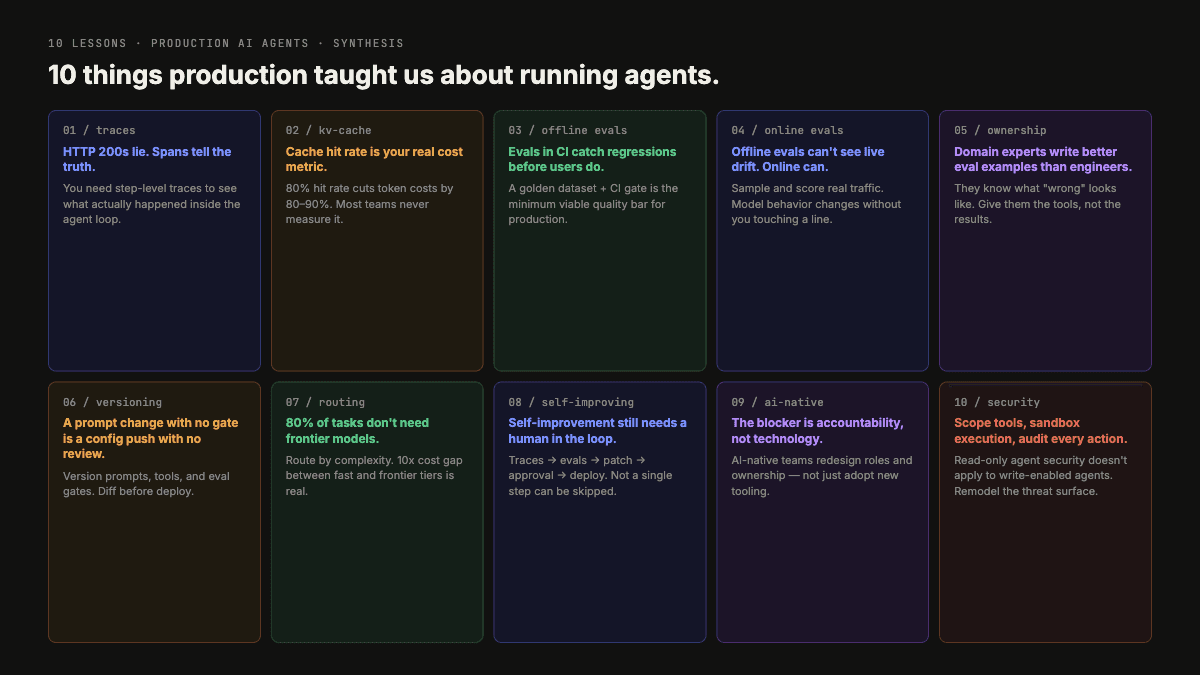
Table of Contents#
- 1. Traces are your primary debugging primitive, and most teams instrument them wrong
- 2. KV-cache hit rate is the most important metric nobody is tracking
- 3. Offline evals in CI/CD are not optional
- 4. Online evals catch what offline evals miss
- 5. Engineers should not own eval datasets
- 6. Prompt versioning is the foundation everything else depends on
- 7. Model routing cuts costs 40 to 80% without touching quality
- 8. Self-improving agents moved from research to commercial product this year
- 9. AI-native engineering requires roles that do not exist in traditional software orgs
- How I Would Run This in Production
- What I Would Measure
- Where This Connects
- FAQ
1. Traces are your primary debugging primitive, and most teams instrument them wrong#
Everyone has logs. Almost nobody has span-level traces that show the full reasoning chain per step. Without that structure, you are doing archaeology on a crime scene. The correct hierarchy is invoke_workflow to invoke_agent to execute_tool. Only 62% of production teams have step-level tracing today, which means the majority cannot answer "which step in a 12-step agent chain caused this failure?" That is a significant blind spot for something you are running in production.
Deep dive: Part 1, Why Your Traces Are Lying to You
2. KV-cache hit rate is the most important metric nobody is tracking#
Manus AI called it "the single most important metric for a production-stage AI agent." Cached tokens on Claude cost one-tenth of uncached, a 10x cost difference on the same content. Your cache gets silently invalidated by unstable JSON serialization in tool definitions, prefix changes in system prompts, or mid-conversation schema updates. Most teams have no idea what their cache hit rate is. Teams that get this right save 49 to 80% on real agent workloads.
Deep dive: Part 2, The 10x Cost Difference Nobody Talks About
3. Offline evals in CI/CD are not optional#
Nearly half of production teams ship prompt changes without running any evaluation suite first. They find out something broke when users complain. A 50-example golden dataset wired into your CI pipeline, blocking merges on quality drops, catches this before users see it. This is not complicated to build. It is just consistently skipped.
Deep dive: Part 3, Offline Evals as a CI Gate
4. Online evals catch what offline evals miss#
Offline evals test what you anticipated. Online evals surface what you did not, distribution shift, behavior drift after a model update, failure patterns that only appear at scale. An agent that passes all your offline tests but fails 20% of production queries tells you nothing in your pre-deploy suite. You need both, and most teams have neither running continuously.
Deep dive: Part 4, Why You Need Both
5. Engineers should not own eval datasets#
This is the one that surprised me most. Uber moved eval ownership from engineers to conversational designers, people who know what "correct" actually sounds like for the domain. BlackRock embedded legal and compliance at the PRD stage, not as sign-off but as co-authors of edge cases. Harvey and Rogo hire ex-lawyers and ex-Goldman bankers as core engineering functions. The pattern is consistent: engineer-owned eval datasets go stale. Domain-owned ones get updated weekly.
Deep dive: Part 5, Who Actually Owns Eval Quality
6. Prompt versioning is the foundation everything else depends on#
A prompt stored as a hardcoded string is unauditable. When quality drops in production, you cannot tell whether it was the prompt change on Tuesday, the model update on Thursday, or something else. Prompts belong in version control with staging environments, the same way application code does. This is not an advanced practice. It is table stakes for being able to diagnose anything.
Deep dive: Part 6, Treating Prompts Like Code
7. Model routing cuts costs 40 to 80% without touching quality#
Claude Haiku 4.5 and Gemini 2.5 Flash handle classification, formatting, routing, and simple generation at 90%+ quality for a fraction of frontier prices. Most teams wire their entire stack to one model and pay frontier prices for tasks that do not need frontier capability. Principled routing, cheap model for simple tasks, escalate only when needed, is where you recover most of your inference budget.
Deep dive: Part 7, Model Routing for Practitioners
8. Self-improving agents moved from research to commercial product this year#
LangSmith Engine closes the loop most teams leave open: traces to failure clustering to root cause diagnosis against your source code to draft PR to regression monitor deployed to failing traces added to your eval dataset. Cogent and Campfire are already using it in production. The trajectory is clear: humans approve fixes today, agents auto-merge low-risk changes in 12 to 18 months.
Deep dive: Part 8, What Self-Improving Agents Actually Means
9. AI-native engineering requires roles that do not exist in traditional software orgs#
Companies using AI as a copilot on top of unchanged processes see marginal gains. Companies that rebuild around AI see 20 to 50% improvements across the SDLC. The structural difference is the operating model, not the tooling. New roles that matter: AI Platform Engineers (shared tooling, eval infrastructure), Agent Wranglers (task decomposition, verification), domain specialists who own eval freshness. None of these exist on the traditional org chart.
Deep dive: Part 9, What an AI-Native Engineering Team Actually Looks Like
10. Security for agentic systems is a present-tense problem#
OWASP published its Top 10 for Agentic Applications in December 2025. 90% of agents are over-permissioned. The risks are different from traditional web security, goal hijacking, memory poisoning, cascading failures across multi-agent systems. EU AI Act high-risk obligations took effect in August 2026. If you are running agents that touch regulated data or make consequential decisions, this is not something to get to eventually.
Deep dive: Part 10, Security for Agents That Actually Do Things
The through-line across all of these is what LangChain diagnosed at Interrupt 2026: agent engineering is still manual, slow, and full of blind spots. The tools to close those blind spots exist now. Whether teams treat them as infrastructure or as optimizations to get to later is what is going to separate the reliable production systems from the ones that quietly fail.
How I Would Run This in Production#
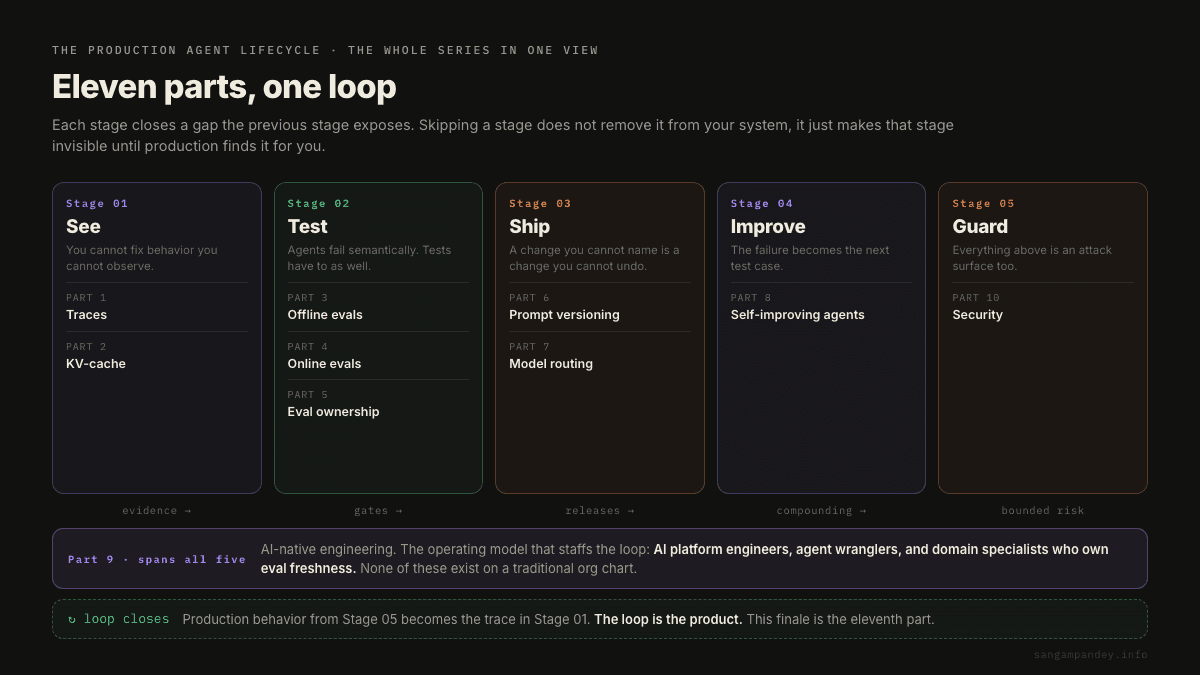
The part that stands out after looking across the whole series is how connected the pieces are. Traces are not just for debugging. They feed eval datasets. Evals are not just tests. They define rollout gates. Prompt versions are not just organization. They make traces and eval failures explainable.
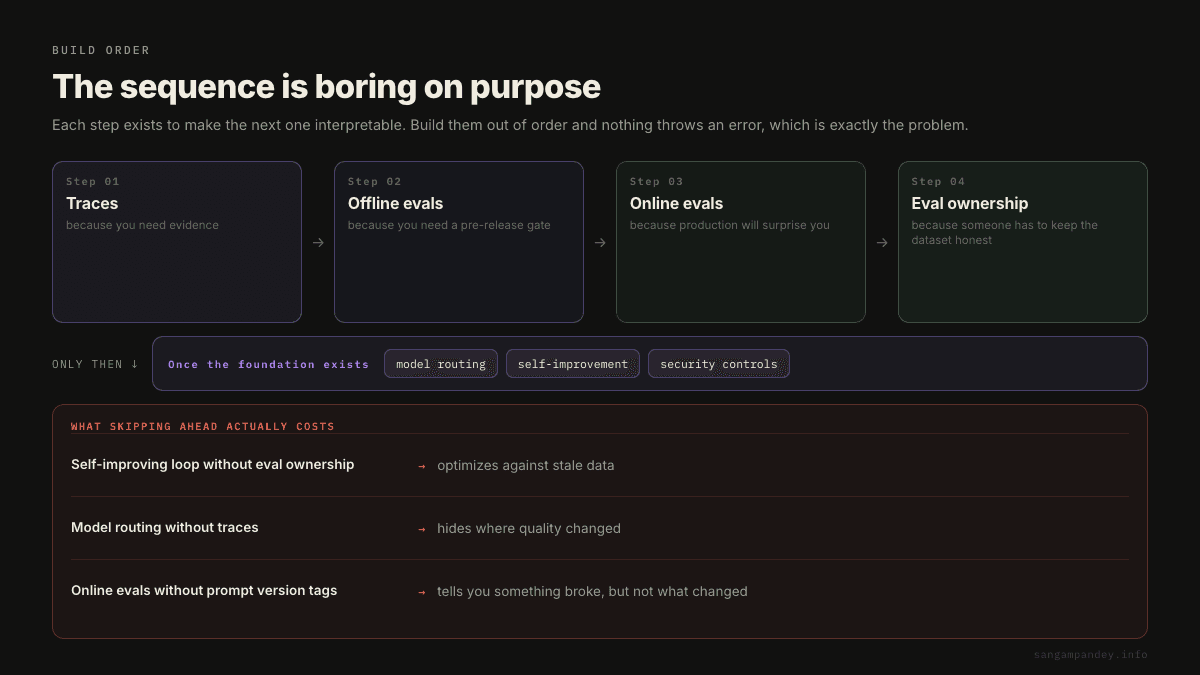
The practical sequence I would use is boring on purpose. Start with traces, because you need evidence. Add offline evals, because you need a pre-release gate. Add online evals, because production will surprise you. Add ownership, because someone has to keep the dataset honest. Then add routing, self-improvement, and security controls once the foundation exists.
Doing this out of order creates strange failures. A self-improving loop without eval ownership optimizes against stale data. Model routing without traces hides where quality changed. Online evals without prompt version tags tell you something broke but not what changed.
The mature version of AI engineering is not a giant agent that handles everything. It is a set of small operational loops that make behavior visible, testable, reversible, and accountable.
What I Would Measure#
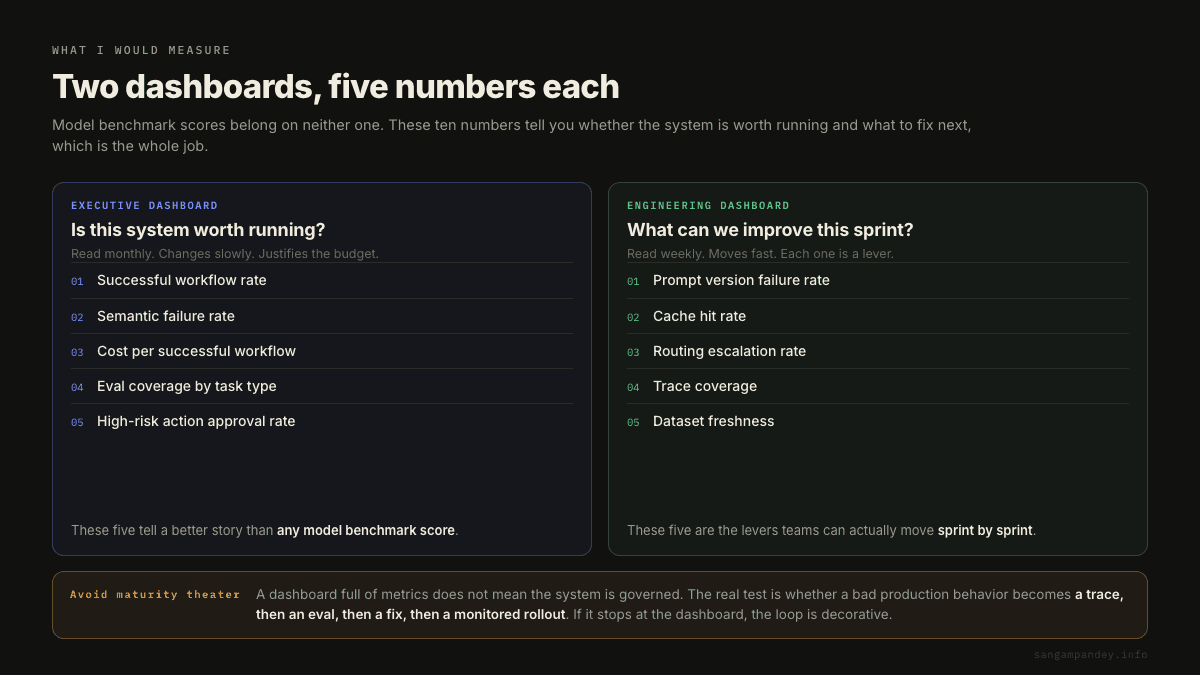
If I had to choose one executive dashboard, it would show five numbers: successful workflow rate, semantic failure rate, cost per successful workflow, eval coverage by task type, and high-risk action approval rate. Those five tell a better story than model benchmark scores.
For engineering, I would add prompt version failure rate, cache hit rate, routing escalation rate, trace coverage, and dataset freshness. Those are the levers teams can actually improve sprint by sprint.
The main warning is to avoid maturity theater. A dashboard full of metrics does not mean the system is governed. The question is whether a bad production behavior becomes a trace, then an eval, then a fix, then a monitored rollout.
Where This Connects#
This post is one piece of the production agent lifecycle. The adjacent pieces matter because the failure usually does not stay inside one layer. A tracing problem becomes an eval problem. An eval problem becomes an ownership problem. A routing problem becomes a cost and security problem if nobody can see what changed.
- Why Your Traces Are Lying to You
- Offline Evals as a CI Gate
- Security for Agents That Actually Do Things
- The 10x Cost Difference Nobody Talks About
- Treating Prompts Like Code
If you are using this as a checklist, read those posts as dependencies rather than as optional background. The stack only becomes reliable when the evidence loop, the release loop, and the security loop all point at the same production behavior.
FAQ#
What is the most important production AI agent lesson?#
The most important lesson is that behavior must be visible before it can be improved. Step-level traces are the foundation for evals, debugging, routing, and security review.
Where should teams start?#
Start with one high-value workflow. Add span-level tracing, a small offline eval suite, prompt version tags, and a simple release gate. Expand only after the loop works.
Why are evals mentioned so often?#
Agents fail semantically, not just technically. Evals are how teams measure whether the agent did the right thing, not merely whether the code executed.
What is the biggest cost lever?#
KV-cache stability and model routing are usually the biggest cost levers. Both require prompt structure, task labeling, and workflow-level cost measurement.
What makes self-improving agents possible?#
They need traces, eval datasets, prompt and code versioning, failure clustering, safe patch proposals, and monitored rollout. Without those pieces, improvement cannot be trusted.
What separates mature teams from immature teams?#
Mature teams treat agents as production systems with observability, tests, owners, budgets, and security boundaries. Immature teams treat them as clever prompts attached to tools.
Implementation Review Checklist#
Before I would call this production-ready, I would ask five questions in the review. First, does the team know which artifact changed because of this lesson? A trace field, eval case, prompt file, routing rule, dashboard, or security policy should be visible in the repo or the runbook. If the only output is agreement, the lesson has not landed yet.
Second, can the team reproduce the failure mode in a lower environment? Production AI work gets messy when the only evidence is a screenshot, a Slack thread, or a vague user complaint. A reproducible example gives the team something concrete to test against after the fix.
Third, does the fix have an owner after the first merge? Most agent systems decay slowly. Datasets go stale, prompts drift, routing rules stop matching traffic, and permissions expand. The owner is the person who notices that drift before it becomes an incident.
Fourth, is rollback obvious? If a prompt, model, parser, evaluator, or security rule makes behavior worse, the team should know how to return to the last known-good version without rewriting the system under pressure.
Fifth, did the incident or improvement strengthen the loop? A good production process compounds. The trace becomes an eval. The eval becomes a gate. The gate becomes a safer release. That is the practical standard I would use for every idea in this series.
I would also ask whether the change makes the system easier to explain to a new teammate. Production AI stacks fail when the important behavior lives in someone s memory. If the reason for a prompt rule, routing threshold, eval example, or tool permission is not written down, the next person will eventually delete it while cleaning up what looks like accidental complexity.
The review should include one negative example. Show the input that used to fail, the trace or eval result that made the failure visible, and the current behavior after the change. This keeps the team grounded in evidence. It also stops the review from becoming abstract, which is where AI engineering discussions often drift.
For agent systems, I would check the cost impact and the quality impact together. A fix that improves quality by calling a frontier model three extra times may be correct for a regulated workflow and wrong for a low-margin support workflow. A cost reduction that removes useful context may look good for a week and then show up as worse user outcomes. The trade-off has to be explicit.
The last check is operational ownership. If the change creates a new dashboard, who looks at it? If it creates a new eval, who updates it? If it creates a new permission boundary, who approves exceptions? The difference between a strong production practice and a temporary cleanup is usually whether the maintenance path is obvious.
None of this needs to be heavy. A short pull request note, one linked trace, one eval case, and one owner are enough for many changes. The point is to leave a trail that future engineering work can build on. That is how AI systems become more reliable over time instead of slowly collecting unexplained rules.
Decision Record Template#
For a production team, I would capture the final decision in a small record with six fields: context, decision, alternatives rejected, evidence, owner, and review date. Context explains the failure or opportunity that triggered the work. Decision states the actual change in plain language. Alternatives rejected keeps the team from relitigating the same path later.
Evidence is the most important field. Link the trace, eval result, cost measurement, screenshot, support ticket, or security review that justifies the change. If there is no evidence, write that down too. It is better to be honest about a judgment call than to pretend the system proved something it did not.
Owner and review date keep the decision alive. Agent systems change quickly because models, providers, prompts, tools, and traffic all move. A decision that is correct in June can become wrong in September. The review date is not bureaucracy. It is a reminder that production AI choices age faster than normal application code.
This template is intentionally small because a large process will not survive contact with a busy engineering team. The goal is not documentation for its own sake. The goal is to leave enough context that the next person can understand why the system behaves this way and what evidence would justify changing it.
That small habit prevents future confusion.