I keep seeing companies announce that they've "embraced AI" in their engineering workflow. Then I ask what changed. The answer is usually some version of: we gave everyone GitHub Copilot, we added ChatGPT to the knowledge base, and we hired a Head of AI who reports to the CTO.
That is not AI-native. That is AI-adjacent. And there is a 20 to 50% SDLC improvement gap sitting between those two things.
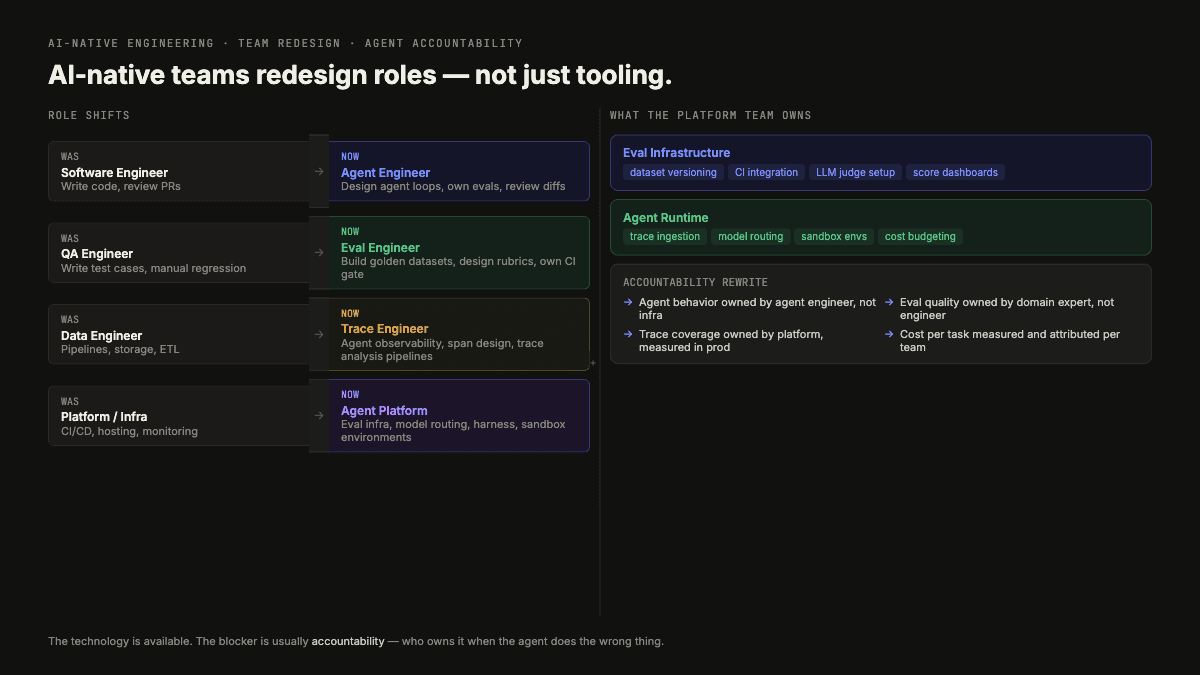
Table of Contents#
- The Six Structural Differences
- 1. Who writes specs
- 2. Context management
- 3. QA ownership
- 4. Eval gates
- 5. Agent oversight
- 6. Failure response
- The Roles That Actually Matter
- The Domain Expert Problem
- How I Would Run This in Production
- What I Would Measure
- Where This Connects
- FAQ
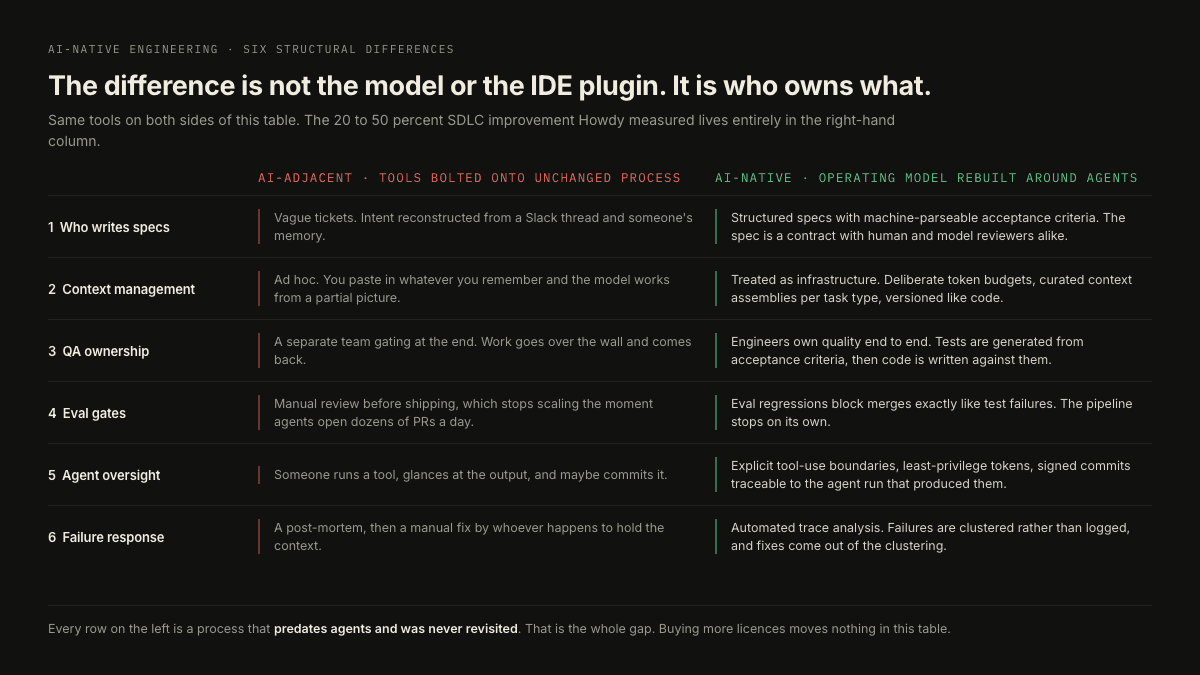
The 2026 Howdy analysis made this explicit: organizations using AI as an add-on to unchanged processes report marginal gains. Those who rebuild their operating model around AI see 20 to 50% improvements across the full software development lifecycle. The difference is not which model they use or which IDE plugin they installed. It is structure. It is who owns what. It is how accountability is distributed when an agent authors a PR.
Let me walk through what the rebuild model actually looks like, because most of what I read on this topic stays at the level of vibes.
The Six Structural Differences#
Six things move when a team rebuilds rather than bolts on. Here they are side by side before I go through each one.
1. Who writes specs#
In a traditional team, engineers get vague Jira tickets. "Add filter functionality to the dashboard." The context is in someone's head, gets partially lost in a Slack thread, and the engineer spends the first two hours trying to reconstruct intent.
In an AI-native team, PMs write structured specs with machine-parseable acceptance criteria. Not because engineers cannot read prose, but because the spec is also the input to an agent. If your acceptance criteria cannot be parsed by a model, you will get unpredictable outputs from automated code generation and test generation. The spec becomes a contract with both human and machine reviewers.
2. Context management#
Traditional teams treat context as ad hoc. You load what you remember into the chat window. You forget to include the relevant service contract. The model works with a partial picture.
AI-native teams treat context as infrastructure. They maintain intentional token budgets, curate context assemblies per task type, and version them. This is not glamorous work. It is the kind of thing that looks like overhead until you've been burned by a plausible-but-wrong output generated from stale or incomplete context.
3. QA ownership#
The traditional model has a separate QA team that acts as a gate at the end of the process. Engineers throw work over the wall; QA throws it back.
In the rebuild model, engineers own quality end to end. AI writes the test suites. The discipline shifts from "write code, then test it later" to "generate tests from acceptance criteria, write code against those tests." The QA function does not disappear; it gets absorbed into engineering judgment about what the tests should actually cover.
4. Eval gates#
Manual review before shipping is not a scalable model when agents are producing dozens of PRs per day. AI-native teams treat eval regressions the same way they treat test failures: they block merges. If your AI-assisted feature regresses on a key eval metric, the pipeline stops. This requires building and maintaining eval datasets, which is non-trivial work. More on that below.
5. Agent oversight#
Most teams that use AI agents have no formalized oversight model. Someone runs a tool, it does something, they look at the output, maybe they commit it.
AI-native teams define explicit tool-use boundaries, issue least-privilege tokens, and track provenance. When an agent adds a dependency, that gets logged. When an agent authors a commit, that commit is signed and traceable to the specific agent run that produced it. This is the foundation of SBOM (software bill of materials) tracking for agent-added dependencies, which is increasingly required for compliance.
6. Failure response#
Post-mortems that lead to manual fixes are the traditional failure response. Slow, inconsistent, dependent on whoever has context.
AI-native teams run automated trace analysis when something fails. Issues get clustered, not just logged. Proposed fixes come out of that clustering, not just from whoever was on call. Humans still make the call, but the initial diagnosis is automated.
The Roles That Actually Matter#
Org charts at AI-native companies do not just have "AI engineers." They have specialized functions that did not exist five years ago.
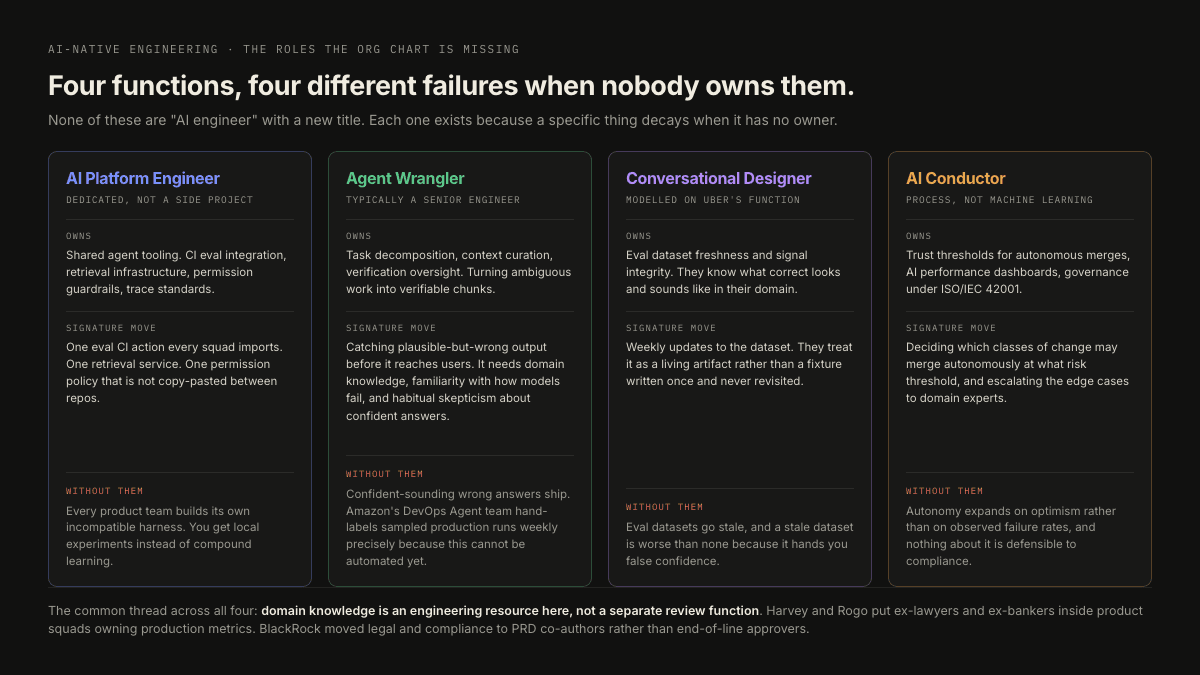
AI Platform Engineers own the shared agent tooling: CI eval integration, retrieval infrastructure, permission guardrails. These are not product engineers who dabble in AI infrastructure. They are dedicated to the plumbing that makes agent workflows reliable. If no one owns this, every product team builds their own incompatible version.
Agent Wranglers are typically senior engineers. Their job is task decomposition, context curation, and verification oversight. The most valuable thing they do: catch plausible-but-wrong outputs before they reach users. This is a real skill. It requires domain knowledge, familiarity with how models fail, and the habit of skepticism about confident-sounding outputs. You cannot train this away or automate it yet. Amazon's DevOps Agent team has team members who manually sample real production runs weekly, hand-label accuracy and failure points, and feed those labeled traces back into formal eval suites. The human judgment in that loop is not replaceable.
Conversational Designers, modeled after what Uber built, own eval dataset freshness and signal integrity. They know what "correct" looks and sounds like for their domain. Engineers, left alone, let eval datasets go stale. Conversational Designers treat the dataset as a living artifact that needs weekly updates. This role exists because the quality of your evals determines the quality of your AI-assisted outputs, and engineers are not usually the right people to maintain eval quality in domains that require deep user-facing judgment.
AI Conductors are an emerging leadership function for orgs that are scaling AI across multiple teams. They review AI performance dashboards, manage trust thresholds for autonomous merges, ensure governance under ISO/IEC 42001, and escalate edge cases to domain experts. This is not an ML role. It is a process orchestration role. The conductor does not train models. They decide which changes can be autonomously merged at what risk threshold, and they maintain the governance structures that make autonomous operation defensible to compliance.
The Domain Expert Problem#
Harvey and Rogo are worth examining here. Both companies hired ex-lawyers and ex-bankers not as consultants but as engineering functions. These people sit in the product squads. They own production metrics. They write the eval criteria for their domain.
BlackRock went a different direction but arrived at the same principle: legal and compliance teams are embedded at PRD stage as co-authors of edge cases, not as approvers at the end of the process. The distinction matters. An approver at the end creates a bottleneck and is working from incomplete context. A co-author at the start shapes what gets built.
The common thread: domain knowledge is an engineering resource in AI-native teams, not a separate review function.
The Accountability Shift Nobody Talks About#
Here is the part that most "AI in engineering" articles skip.
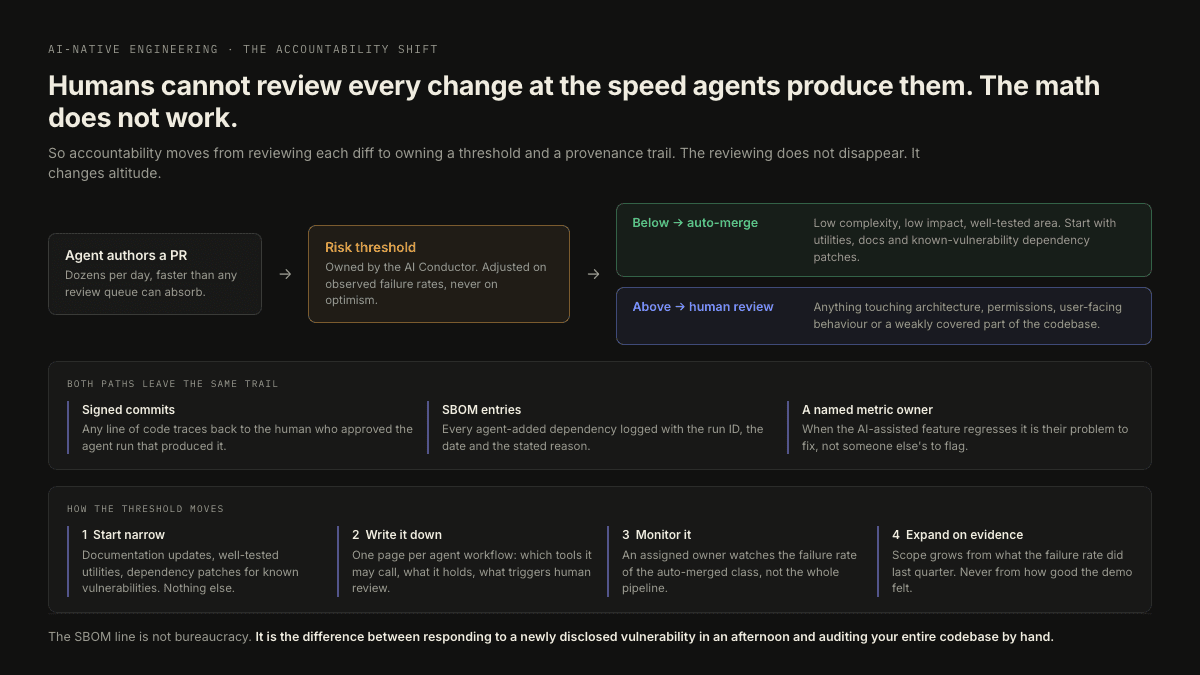
When agents author code and PRs at scale, humans cannot review every change at the speed agents produce them. The math does not work. So how do you maintain accountability?
Organizations that handle this well use scope-limited autonomous merges: agents can autonomously merge changes that fall below a defined risk threshold. Low-complexity, low-impact changes in well-tested areas. Higher-risk changes still require human review. The AI Conductor owns the thresholds and can adjust them based on observed failure rates.
They also maintain SBOM tracking for agent-added dependencies. Every dependency an agent introduces gets logged with the agent run ID, the date, and the stated reason. This is not bureaucracy for its own sake. It is the difference between being able to respond quickly when a new vulnerability is disclosed and having to audit your entire codebase manually.
Signed commits for agent-authored changes maintain provenance. You can trace any line of code back to the human who approved the agent run that produced it.
The Common Failure Pattern#
Companies hire a "Head of AI" who sits adjacent to engineering. They advise on tooling. They run lunch-and-learns. They evaluate vendors. They produce no production work and own no production metrics.
This is the add-on model dressed up with a job title. The person has organizational visibility but no accountability for outcomes.
The rebuild model looks different. AI engineers sit in product squads with domain experts. They own production metrics, not advisory relationships. They are responsible for eval quality in their domain. When the AI-assisted feature regresses, it is their problem to fix, not someone else's to flag.
Four Things to Do If You Want to Actually Rebuild#
These are concrete, not aspirational.
-
Audit your eval coverage before you expand agent autonomy. If you do not have maintained eval datasets for the domains where agents are operating, you have no ground truth. Start there. Assign ownership. Set a cadence for updates. Stale evals are worse than no evals because they give you false confidence.
-
Formalize agent oversight boundaries in writing. Define which tools each agent type can call, what permissions it holds, and what triggers human review. This does not have to be complex. A one-page doc per agent workflow is enough to start. The goal is to make the implicit explicit so you can reason about failure modes before they occur in production.
-
Move domain experts upstream. If your lawyers, compliance people, or domain specialists are reviewing outputs after engineering, move them to PRD stage. Have them co-author the acceptance criteria and the eval cases. The cost of catching a wrong assumption at the spec stage is a conversation. The cost of catching it after an agent has written 3,000 lines of code is a rewrite.
-
Define your autonomous merge policy. Decide, explicitly, what class of changes can be autonomously merged and under what conditions. Start narrow: well-tested utilities, documentation updates, dependency patches for known vulnerabilities. Document the thresholds, assign an owner to monitor failure rates, and expand the scope based on observed outcomes. Do not expand it based on optimism.
The 20 to 50% improvement number from Howdy is real, but it is not a gift. It is the outcome of teams that did the structural work, not the teams that issued everyone a chatbot subscription and called it transformation.
How I Would Run This in Production#
I would not start by buying more licenses. I would start by mapping the work. Which parts of the software lifecycle are repetitive, which require domain judgment, which require architectural taste, and which are blocked by missing context? The answers determine the operating model.
The first structural change is a shared AI platform function. Someone has to own model access, prompt versioning, eval infrastructure, trace standards, routing, and security defaults. If every product team builds its own harness, the organization gets local experiments instead of compound learning.
The second change is task decomposition. Agent wrangling is not prompt magic. It is the ability to turn ambiguous work into verifiable chunks, give agents the right context, and inspect outputs without becoming the bottleneck. That skill sits somewhere between tech lead, QA, and product thinking.
The third change is accountability. If an agent ships a bug, the responsible team still owns it. AI-native does not mean responsibility moves to the model. It means the team has better tools and a larger surface area to govern.
What I Would Measure#
Measure cycle time, review load, escaped defects, eval coverage, agent task success rate, and rework after AI-generated changes. Productivity claims are weak if they ignore rework and review burden.
I would separate adoption metrics from outcome metrics. The number of AI tool users tells you whether people tried the tool. It does not tell you whether the organization got faster or safer. Outcome metrics need to follow real work through delivery.
The best signal is whether teams reuse each other s patterns. Shared prompts, eval templates, trace schemas, and harness components show that the organization is compounding knowledge instead of rediscovering the same lessons in every team.
Where This Connects#
This post is one piece of the production agent lifecycle. The adjacent pieces matter because the failure usually does not stay inside one layer. A tracing problem becomes an eval problem. An eval problem becomes an ownership problem. A routing problem becomes a cost and security problem if nobody can see what changed.
- The Five Pillars of Agentic Engineering
- The AI-Native Engineer Is Not Who You Think
- Claude Code in Production: What Senior Engineers Actually Need to Know
- 10 Lessons From Production AI Agents
- Who Actually Owns Eval Quality
If you are using this as a checklist, read those posts as dependencies rather than as optional background. The stack only becomes reliable when the evidence loop, the release loop, and the security loop all point at the same production behavior.
FAQ#
What makes an engineering team AI-native?#
An AI-native team redesigns workflow, infrastructure, evaluation, review, and ownership around AI-assisted work. It is not just a traditional team with chatbots added.
What new roles matter most?#
AI platform engineers, agent workflow owners, domain eval owners, and reviewers who understand agent-generated changes matter more than generic prompt specialists.
How should productivity be measured?#
Measure cycle time, review effort, escaped defects, rework, eval coverage, and cost per delivered change. Do not rely only on lines of code or tool adoption.
Does AI-native mean fewer engineers?#
Not necessarily. It usually means engineers spend less time on repetitive execution and more time on decomposition, review, architecture, and product judgment.
What is the common failure mode?#
The common failure is layering AI tools onto unchanged process. Teams get modest gains, then stall because review, context, security, and evaluation were never redesigned.
Where should a team start?#
Start with one repeatable workflow that has clear success criteria, good context, and manageable risk. Build the eval and review loop around that workflow before expanding.
Implementation Review Checklist#
Before I would call this production-ready, I would ask five questions in the review. First, does the team know which artifact changed because of this lesson? A trace field, eval case, prompt file, routing rule, dashboard, or security policy should be visible in the repo or the runbook. If the only output is agreement, the lesson has not landed yet.
Second, can the team reproduce the failure mode in a lower environment? Production AI work gets messy when the only evidence is a screenshot, a Slack thread, or a vague user complaint. A reproducible example gives the team something concrete to test against after the fix.
Third, does the fix have an owner after the first merge? Most agent systems decay slowly. Datasets go stale, prompts drift, routing rules stop matching traffic, and permissions expand. The owner is the person who notices that drift before it becomes an incident.
Fourth, is rollback obvious? If a prompt, model, parser, evaluator, or security rule makes behavior worse, the team should know how to return to the last known-good version without rewriting the system under pressure.
Fifth, did the incident or improvement strengthen the loop? A good production process compounds. The trace becomes an eval. The eval becomes a gate. The gate becomes a safer release. That is the practical standard I would use for every idea in this series.
I would also ask whether the change makes the system easier to explain to a new teammate. Production AI stacks fail when the important behavior lives in someone s memory. If the reason for a prompt rule, routing threshold, eval example, or tool permission is not written down, the next person will eventually delete it while cleaning up what looks like accidental complexity.
The review should include one negative example. Show the input that used to fail, the trace or eval result that made the failure visible, and the current behavior after the change. This keeps the team grounded in evidence. It also stops the review from becoming abstract, which is where AI engineering discussions often drift.
For agent systems, I would check the cost impact and the quality impact together. A fix that improves quality by calling a frontier model three extra times may be correct for a regulated workflow and wrong for a low-margin support workflow. A cost reduction that removes useful context may look good for a week and then show up as worse user outcomes. The trade-off has to be explicit.
The last check is operational ownership. If the change creates a new dashboard, who looks at it? If it creates a new eval, who updates it? If it creates a new permission boundary, who approves exceptions? The difference between a strong production practice and a temporary cleanup is usually whether the maintenance path is obvious.
None of this needs to be heavy. A short pull request note, one linked trace, one eval case, and one owner are enough for many changes. The point is to leave a trail that future engineering work can build on. That is how AI systems become more reliable over time instead of slowly collecting unexplained rules.